
Deconstructing Ohsawa’s And Michio’s YinYang Theory And Applications
Problems In The Macrobiotic YinYang Pedagogy

First of all, Ohsawa’s and Michio’s descriptions of the dynamic interplay between between Yin and Yang as listed in their various versions of the “Twelve Theorems” are not really an issue that needs to be discussed. They primarily describe the behavior of polar opposites and the oscillations and movements of various phenomena that we can easily understand and readily observe around us such as, for example, the attraction and repulsion of magnets, of sub-atomic particles, of energy waves and so on.
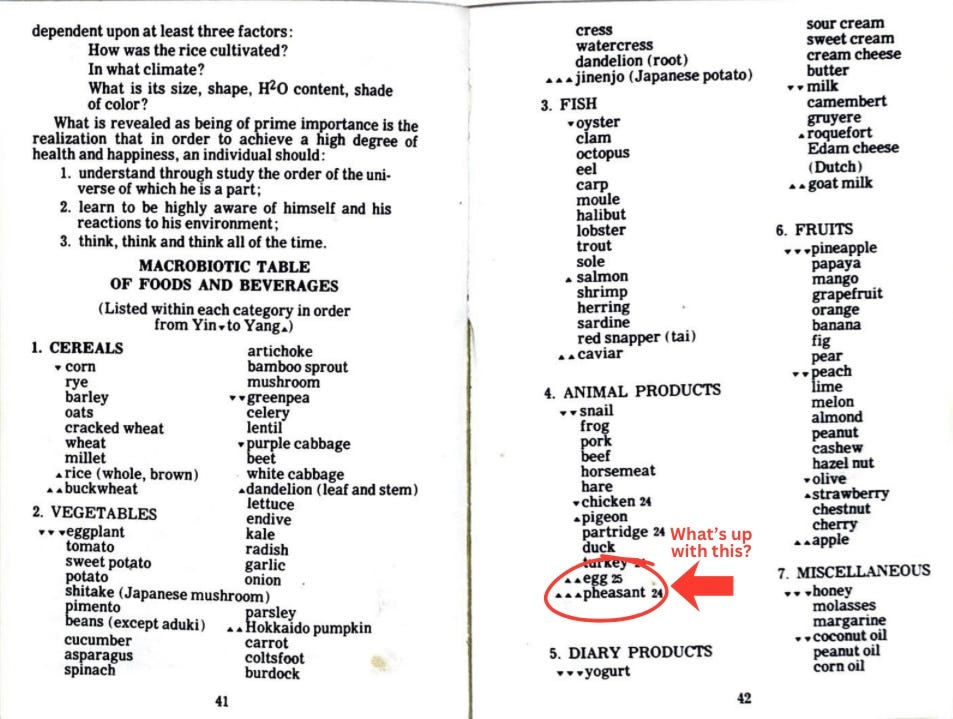
Problems arise, however, when these teachers offer lists of phenomena or attributes and assign them as either yin or yang. Particularly concerning is Ohsawa’s list of foods in YinYang order as written in his book, “Zen Macrobiotics”. (See image above). The first problem is the rationale used to determine whether a thing is yin or yang, which is never fully explained and is based more on subjective opinion and personal experience than on objective reality and empirical data.
(He does suggest that we “think, think, and think again” which is a nice encouragement for us to be independent but still does not explain his process.) The second problem is the loss of dynamic movement when seemingly static objects are assigned a yinyang attribute. It makes such objects appear as unchanging in their yinyang designations.
Both of these problems create a third problem which is that Ohsawa and Michio (and anyone else who makes yinyang lists) becomes the default authority on what is yin and what is yang, effectively taking away he ability for others to determine what is yin and what is yang in any objective way.
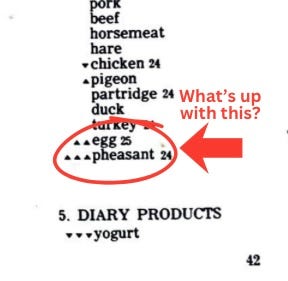
So, for example, In his list of foods in yinyang found in his book, “Zen Macrobiotics”, under animal foods, Ohsawa puts pheasant meat as more yang (triple yang symbol) than eggs. Why is that? Surely eggs are the most yang animal food based on the rationale he outlines in his book. Then why would he place pheasant meat as being more yang than an egg? Would a pheasant egg be even more yang than pheasant meat or is pheasant meat strangely and particularly more yang than its own egg? Although he gives some ideas of the rationale of his yinyang logic these do not fully explain such inconsistencies. Below are image scans from the section of his chapter on yinyang theory in his book, “Zen Macrobiotics” where he outlines his logic and rationale for assigning yin and yang to phenomena and food.
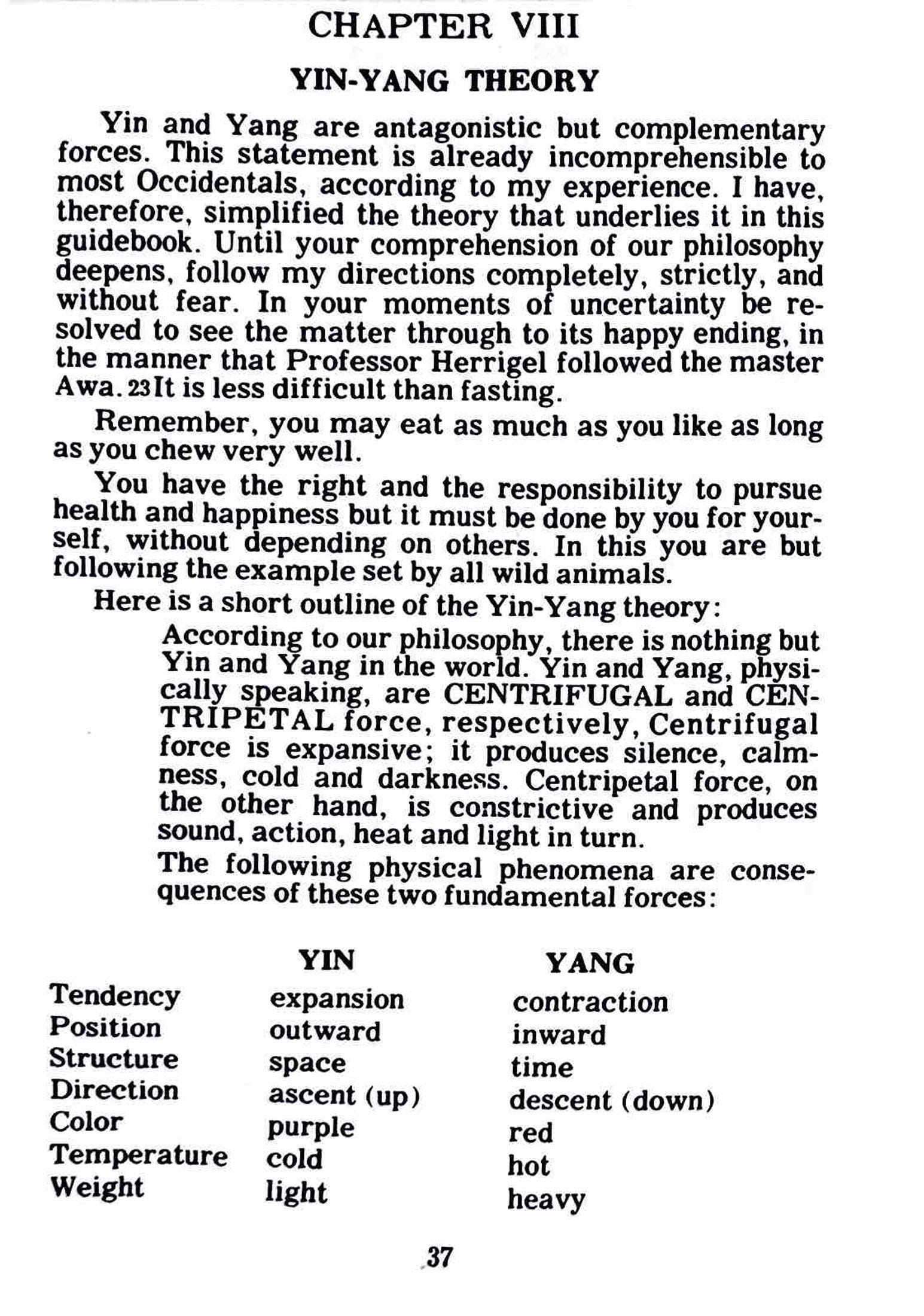
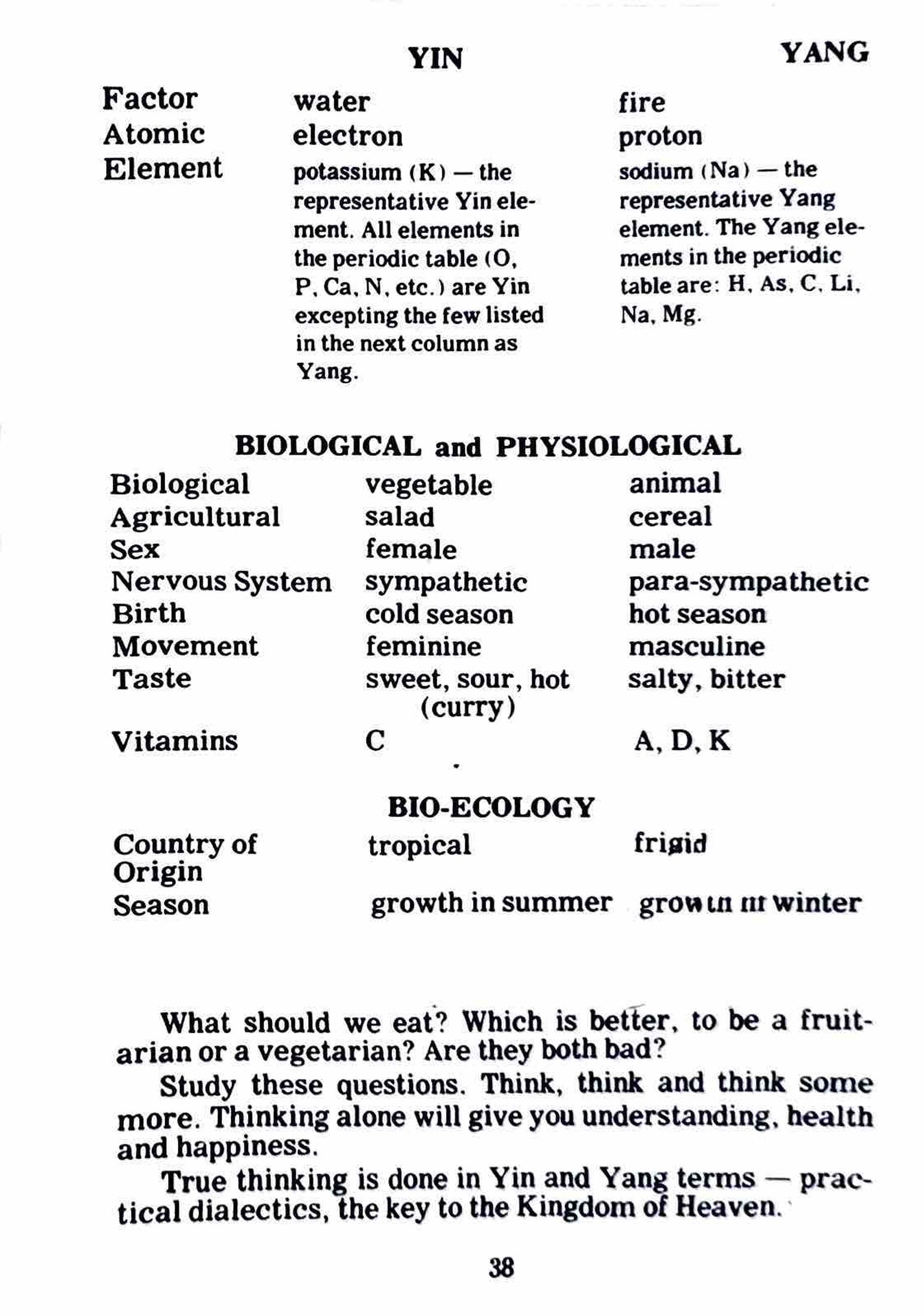
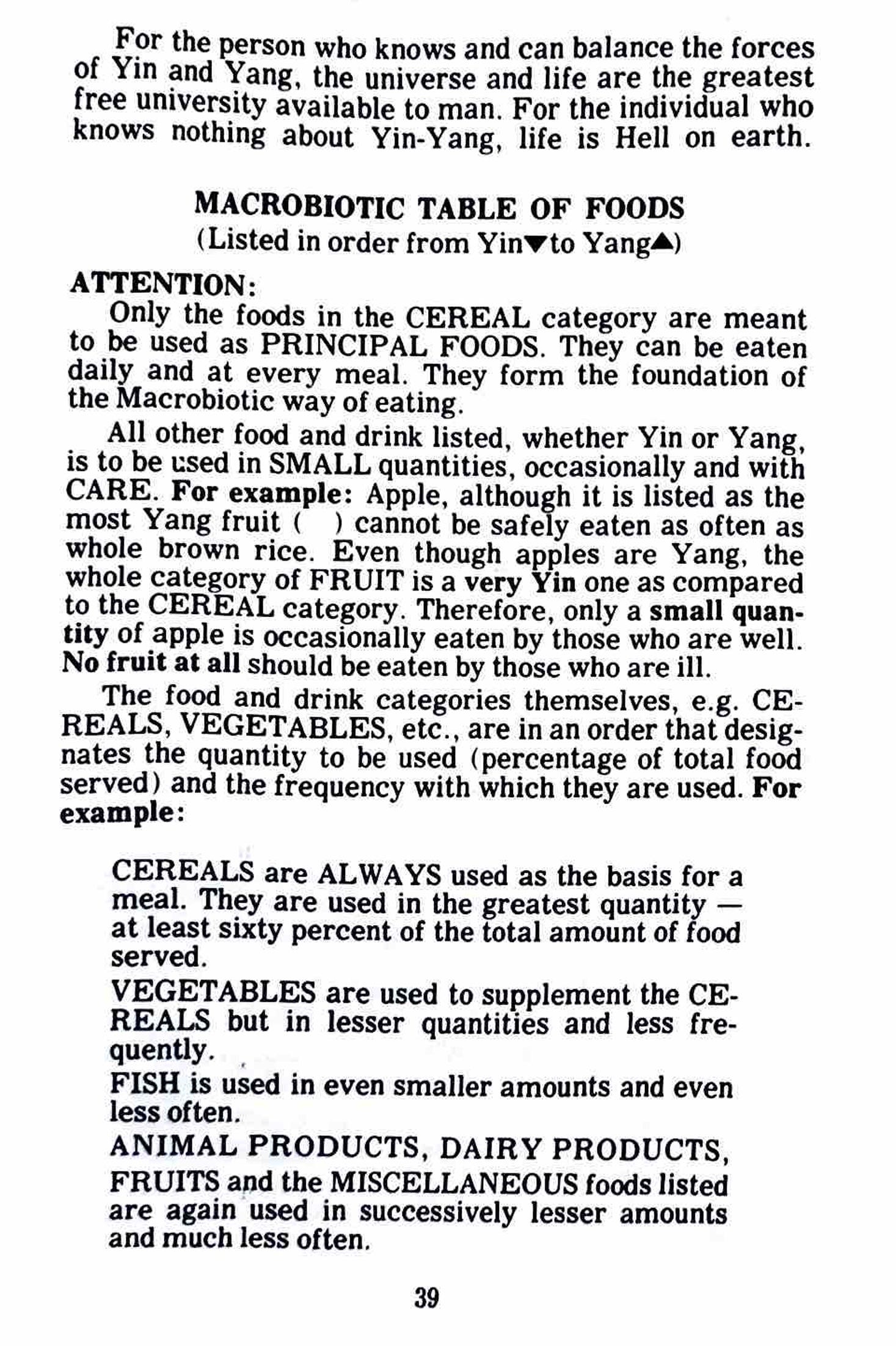
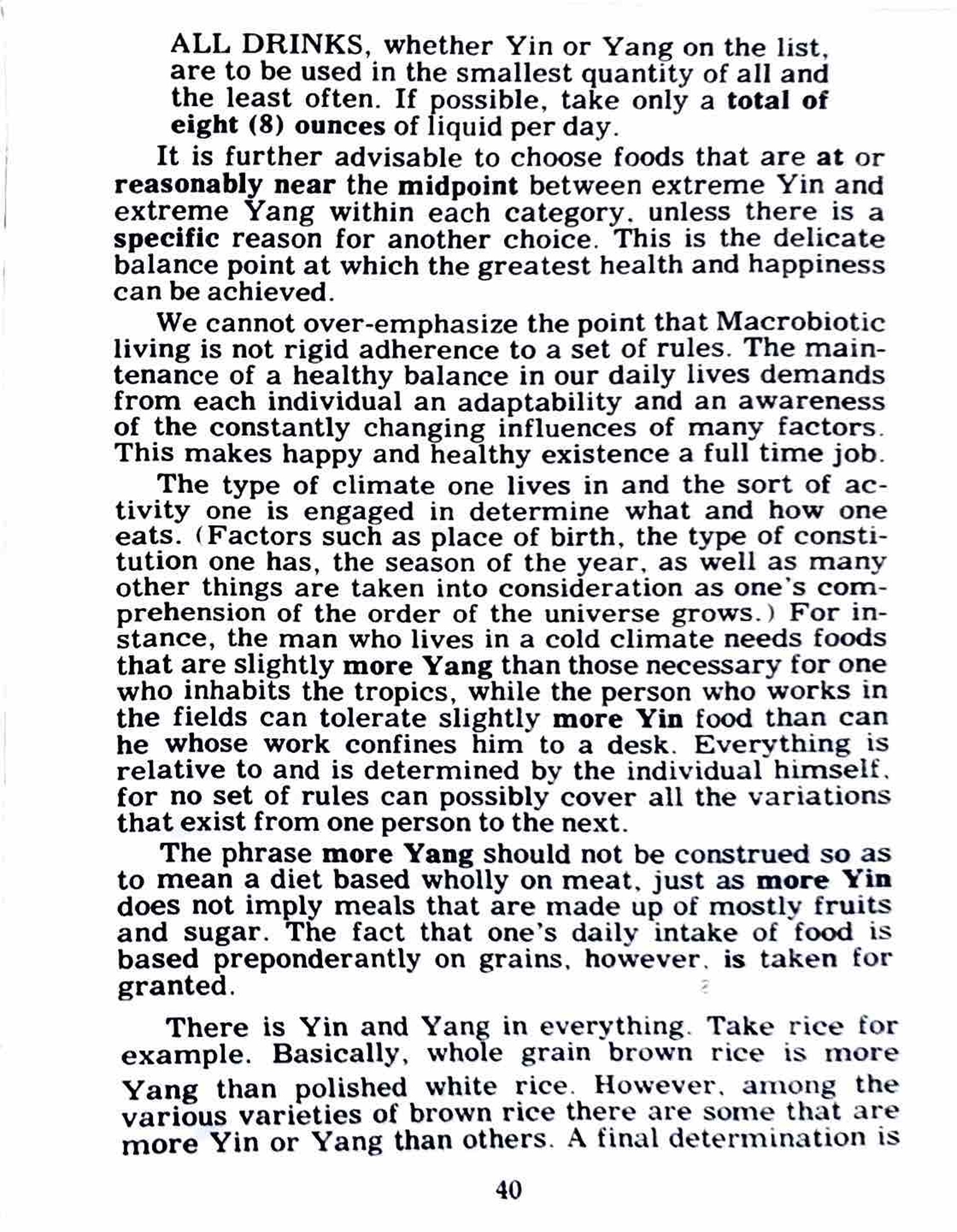
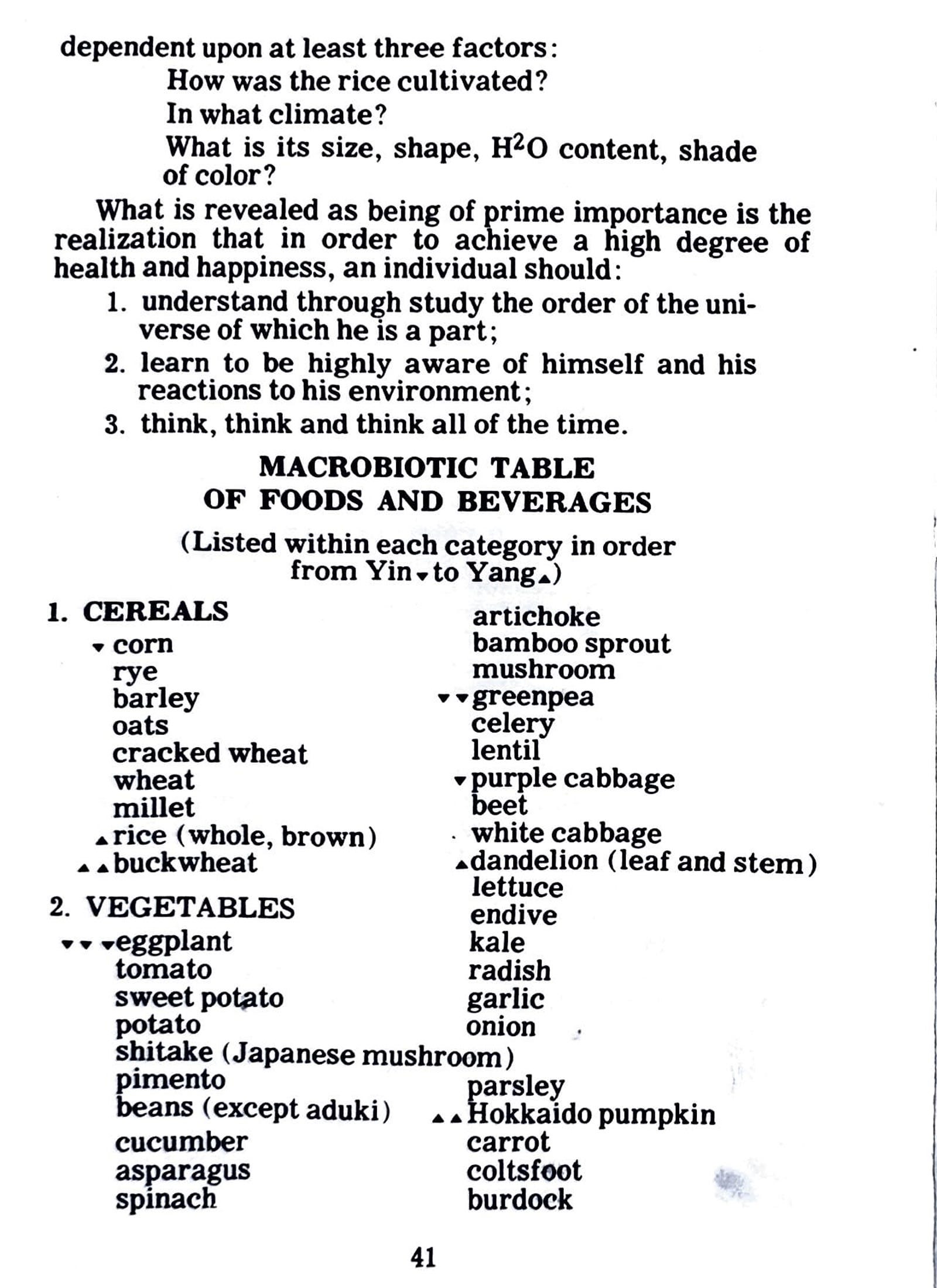
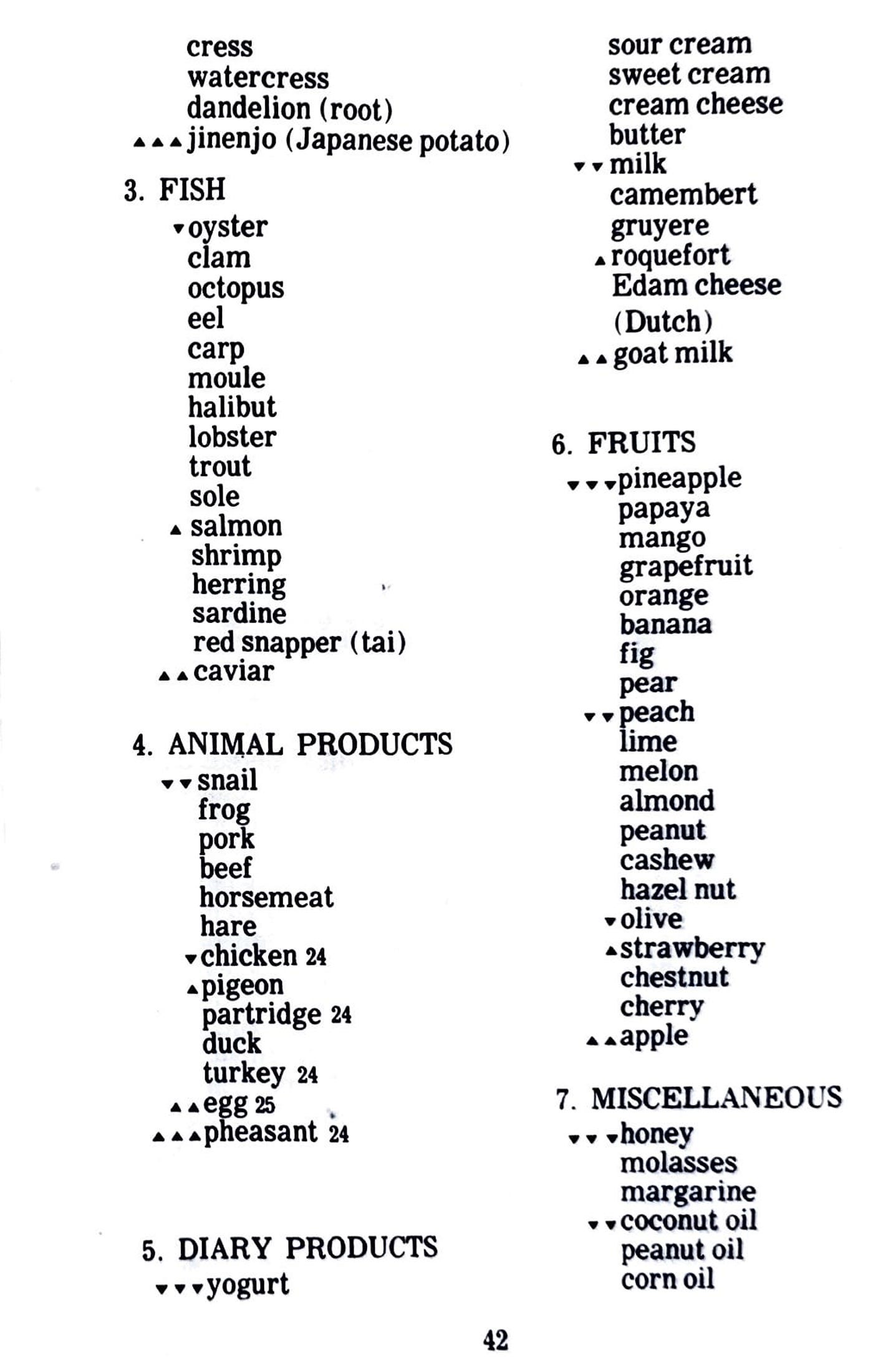
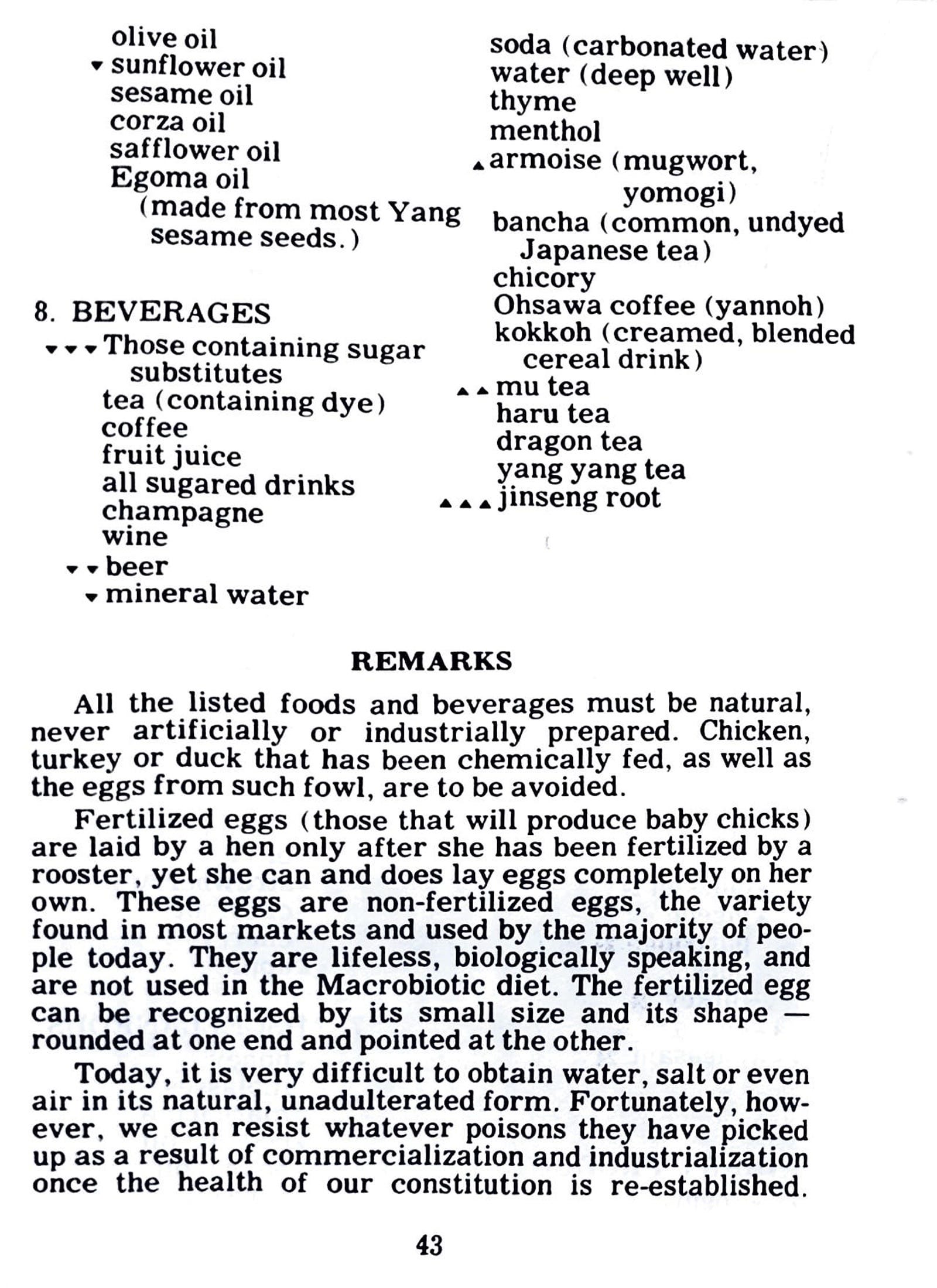
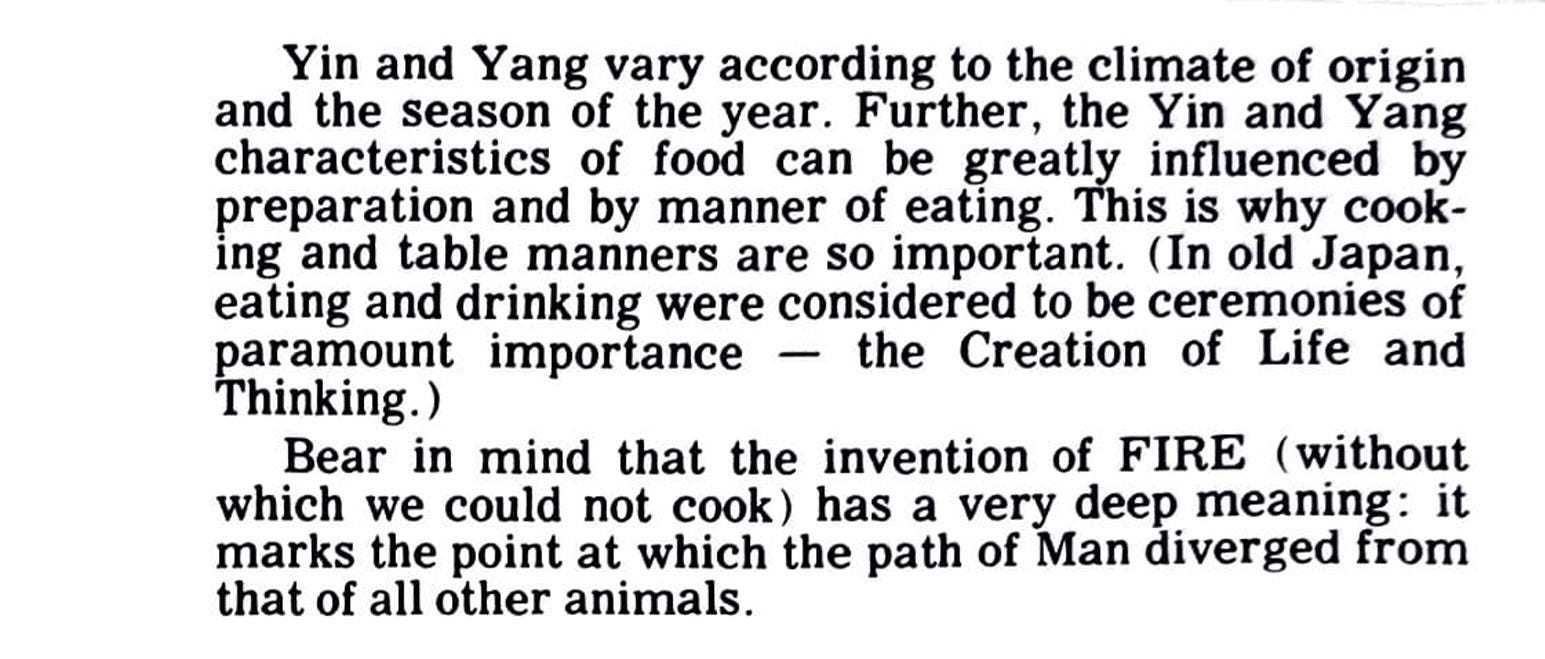
(Note: after this Ohsawa talks about recipes)
We will never know what he was thinking when he placed pheasant meat as being more yang than eggs as we can not ask Ohsawa what his rationale was in assigning these specific yang attributes. Are we to then consider these lists to be subjective interpretations or are they objective facts based on empirical evidence and observations? Without any consistent, logical and objectively repeatable observation and experimentation then we must consider his list to be subjective in nature. This problem isn’t limited to Ohsawa’s list but occurs anytime any list is created which assigns a yin or yang attributes to phenomena.
By making these lists Ohsawa and Michio (and others later) become the default authority of their time on what is yin and what is yang. If I or anyone had a question whether something was yin or yang then Ohsawa (and later Michio) would be the final authority on the matter. How they decided what was yin and what was yang remains mostly inexplicable despite their efforts to explain and teach the logic of their thinking.
Many of Michio‘s earlier lectures were designed to teach his students how to apply yin and yang to all kinds of phenomena from food, to diagnosis, to history and world peace. But try as he did, he could not fully impart his yinyang wisdom onto others. As a result, many of his students do not teach yin and yang and instead explain Macrobiotics in terms of nutritional science or they defer to the yinyang applications found in the textbooks of Traditional Chinese Medicine. Overtime, whatever wisdom that existed in macrobiotic yinyang has faded away and will eventually disappear unless we can remedy these problems, not just for ourselves, but also for future generations to come.
We will look at this in my next article.
Phiya,
I have addressed the phenomenon you describe in the new series, "The Greatest Mind and Body Superpowers in the World," which am currently developing on Substack. Homeostasis- how values move in the body around a balanced center bandwidth- has been there all along as the central principle explaining the movement of values in every bodily function, in the science of contemporary Western medicine. Ohsawa and Michio knew this, and it offers a way to explain/illustrate the process in real time with many examples familiar to most folks: blood sugar levels, blood pressure, heart rate, hormone levels, etc.
Slightly frozen early explanations in the 1950s and '60s by the Senseis are more of a dictum or organizing principle to be used, however dynamically, for understanding and explaining the process of change. One obstacle to subsequent teachers/disciples gaining greater ease in explaining adaptation and balance, I have noticed, is that, too often, Y/Y theory was taught as static, as you suggest, out of the context of the five stages of transformation of energy in Traditional Chinese Medicine, in which these dynamic flows are embedded.
The five transformations (unfortunately too often labeled the 'five elements' - giving it a static attribute) teachings of how change occurs, cycling between polar opposite values, and through the feeding, controlling, and weakening processes, were presented and published by Michio. However, this central aspect of traditional Chinese medicine required much memorizing and logical exercises to match the complexities of the seasons and other manifestations of change; such value calculations have become, and remain, a big hurdle for most folks in getting a working understanding of how the body works.
Dedicated early students and later graduates of the Becket stages Program got closer perhaps than most folks, but I believe the vast majority of folks who manage to live their lives in balance don't bother trying to match every food item to every season. Dedicated practitioners, yes, get it, but not most folks who are just looking for health and/or longevity.
My sense is that, going forward, the current and next generations of MB firebrands who follow us, and the earliest Michio generation of students, now all in our senior years, are tasked with making these principles simple to understand. Not through definitions but in everyday conversations about the ways they affect us, in small moments of need, not necessarily in standalone, protected, shared, lively learning environs like you, I, and our generation had.
As you point out, it is not about static points but of constant motion, in our bodies and in our thoughts and feelings. Teaching Yin and Yang becomes more knowable in everyday life when it is presented as the underlying mechanism that explains how this or that changes. As we try to do.
Anyway, thank you for going through this process publicly with us. Please keep it up. Let's see if we can generate some discussion about these and other related issues that remain 'in process' of further development for understanding. As Guatama, the Awoken One, taught, do not accept teachings as true because great avatars taught them, or because they are in sacred books, or because everyone believes them. Practice and discover this wisdom, in vivo, as you go.
Again, gracias. Looking forward to more of this conversation, Phiya. Many blessings, little brother ( I am much older than you, so I can say that!). Carlos Aponte
Phiya, how can I access the articles on your websites?